logo.png)
Contractor vs Builder vs Architect: What Is the Difference?

Introduction
📑 Table of Contents
- What does an architect do?
- What does a contractor do?
- What does a builder do?
- Architect vs Contractor: What's the real difference?
- Builder vs contractor: Are they the same?
- Do you really need an architect to build a house?
- Can an architect work with my contractor?
- What happens if you start construction without proper drawings?
- Who should you hire first?
- A simple way to remember the difference
- Before you hire anyone, ask these questions
- FAQs
Contractor vs Builder vs Architect: What Is the Difference?
If you are planning to build a house, you have probably come across three terms again and again: architect, builder, and contractor.
At first, they may sound like different names for people who do the same job. But they actually have different roles in the construction process.
An architect helps you plan and design the building. A contractor is involved in executing the construction work. A builder may take responsibility for managing the overall construction of the project.
The confusion usually starts because these roles can overlap. Some builders also work with architects, some contractors offer design services, and some companies handle both design and construction.
So, before you start your project, it is worth understanding what each professional actually does.
What does an architect do?
An architect is usually involved at the beginning of a project, when the idea of the building is still being developed.
For a home, this starts with understanding how you want to use the space. How many bedrooms do you need? Do you want a large kitchen? Where should the living room be? How much natural light do you want? Do you need space for a home office, a garden or parking?

An architect brings these requirements together and develops them into a workable design.
But architecture is not only about deciding how a house should look.
The architect also considers the site, orientation, natural light, ventilation, movement through the house, materials, proportions and the relationship between different spaces.
Once the design develops, the architect may prepare drawings such as floor plans, elevations, sections and detailed drawings that help explain how the building should be constructed.
Key Insight: This is why good architectural planning can make a difference long before the first brick is laid.
Then, what does a contractor do?
A contractor is primarily concerned with executing the construction work.
Once there is an approved design and a clear scope of work, the contractor works on turning those drawings into an actual building.
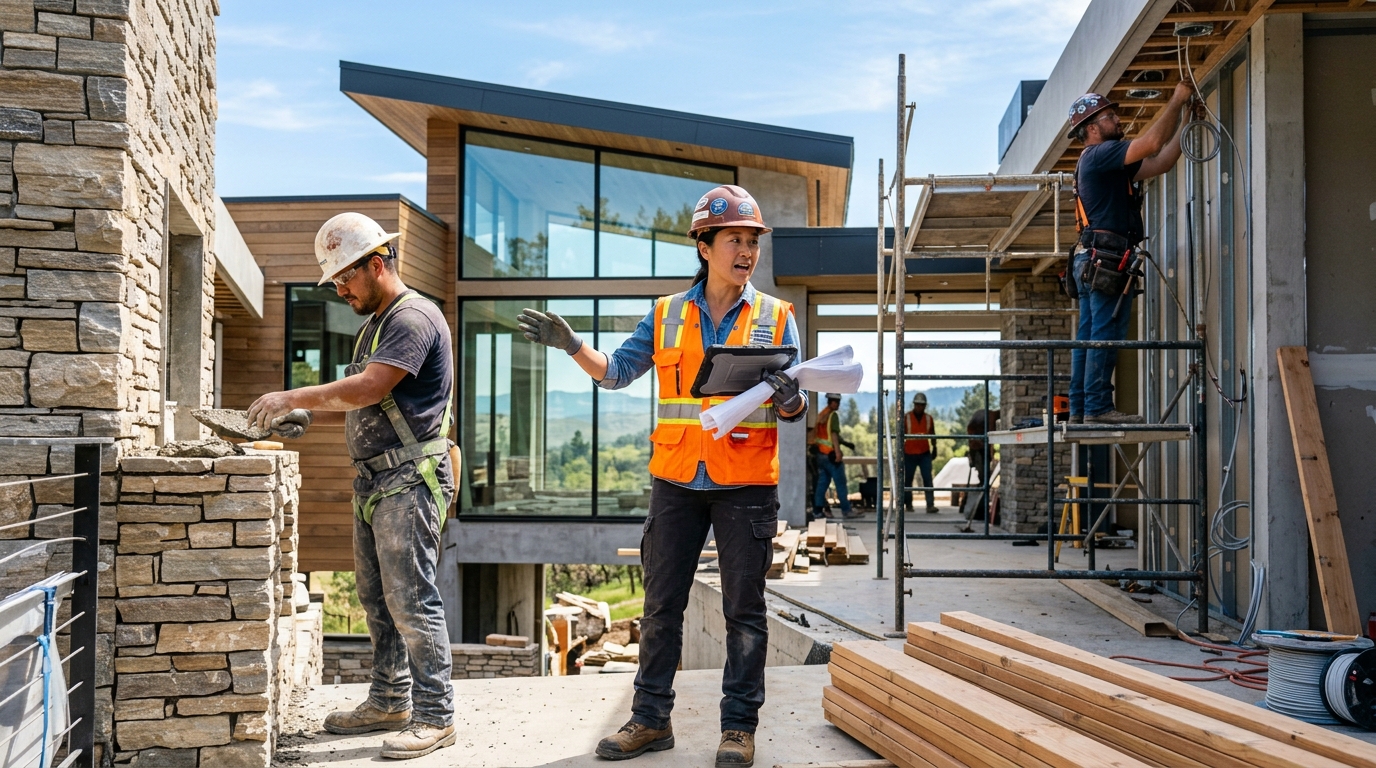
Depending on the agreement, this can involve arranging labour, coordinating different trades, managing materials and suppliers, and handling day-to-day construction activities at the site.
For example, a house may require masons, electricians, plumbers, carpenters, painters and several other specialists. A contractor may coordinate these different people so that the work happens in the required sequence.
The exact responsibility of a contractor depends on the project and the contract. A contractor may be responsible for a particular part of the work or may manage most of the construction.
What does a builder do?
The word builder is used quite broadly, and this is one reason people often get confused.
A builder generally focuses on getting the building constructed and may take responsibility for managing the overall construction process.
Direct Employment
In some projects, the builder may directly employ workers and manage on-site trades themselves.
Subcontracting
In others, they may coordinate different contractors and specialized subcontractors for specific packages.
Integrated Services
A builder may also offer design-related services or work in close partnership with an architect.
So, there isn't always a strict line between a builder and a contractor. Their responsibilities depend largely on how the project is structured and what has been agreed with the client.
This is why it is more important to ask "What will you be responsible for?" than simply asking whether someone is a builder or contractor.
Role Comparison: Architect vs Contractor vs Builder
| Professional | Primary Focus | Key Responsibilities | When Involved |
|---|---|---|---|
| Architect | Design & Spatial Planning | Concept, floor plans, elevations, light & ventilation, aesthetics, working drawings | From project conception to handover |
| Contractor | Work Execution | Executing drawings, managing daily labor, procurement of materials, quality execution | During construction phase |
| Builder | Overall Construction Management | Overseeing total construction delivery, coordinating trades, managing project schedules | Throughout build & handover |
Architect vs Contractor: What's the real difference?
The easiest way to understand it is to think about design versus execution.
An Architect
Develops the design and works out how the spaces, materials and building elements should come together.
A Contractor
Takes that information and carries out the physical construction work on site.
For example, imagine you want a three-bedroom home.
The architect may decide how the bedrooms relate to the living spaces, where windows should be placed, how the house responds to the site and how the overall design should work.
The contractor then works on constructing those elements at the site.
Of course, there needs to be communication between both sides. A design has to be practical to build, and construction has to follow the intent of the design.
Builder vs contractor: Are they the same?
Not exactly, although the terms are sometimes used interchangeably.
A builder may manage the overall construction of a project, while a contractor may be appointed to execute particular construction work.
For example, a builder could coordinate the entire project and appoint separate contractors for electrical, plumbing, or specialized work.
On a smaller residential project, however, one contractor might handle most of these responsibilities.
There is no universal rule that says every builder or contractor must have exactly the same responsibilities. The contract and project structure matter.
Do you really need an architect to build a house?
This is another common question.
If you are building a house, it can be tempting to think about the construction first: find a contractor, get an estimate and start work. But many important decisions need to be made before construction begins:
Where will the staircase go without eating up usable living space?
How will natural sunlight and cross-ventilation enter the bedrooms?
Will furniture fit comfortably without obstructing pathways?
Where will electrical switchboards and plumbing service lines run?
How will the kitchen connect seamlessly with the dining area?
Will there be enough wardrobe, loft, and utility storage planned?
These decisions are much easier to resolve on paper than after construction has started.
An architect helps bring these decisions together into a coherent design.
At LEAD, architectural design is approached as more than just creating an attractive elevation. The practice focuses on the relationship between aesthetics, functionality, sustainability and detailed documentation.
Can an architect work with my contractor?
Yes.
In fact, it is quite common for the architect and contractor to be separate professionals.
The architect can develop the design and drawings, while the contractor handles construction.
This arrangement can work well when everyone understands their responsibilities and communicates properly.
The important thing is to establish this clearly at the beginning of the project.
What happens if you start construction without proper drawings?
This is where things can become complicated.
A contractor may be able to construct a building based on basic plans, but a lack of detailed planning can lead to decisions being made on site:
A window may need to move because it interferes with structural beams or adjacent walls.
A plumbing line may interfere with another structural element or door clearance.
An electrical point may end up in the wrong location, requiring breaking finished plaster.
A room may feel smaller than expected once actual furniture dimensions are considered.
Small changes can sometimes lead to additional cost, delays and rework.
Detailed architectural documentation helps reduce this uncertainty by resolving more of these decisions before construction.
This is also why interior requirements should ideally be considered during the architectural planning stage rather than being treated as something to decide after the building is complete.
So, who should you hire first?
There isn't one answer for every construction project.
For a custom home, many homeowners begin with an architect because the design needs to be established before construction can be properly planned.
Once the design and required drawings are ready, a contractor or builder can be appointed to execute the work.
There are also design-build projects, where design and construction are handled as part of one integrated service.
Both approaches can work. What matters is knowing who is responsible for each part of the project.
A simple way to remember the difference
If all these terms still sound confusing, think about it this way:
Architect:
"What should we build, and how should it work?"
Builder:
"How do we organise the construction of the building?"
Contractor:
"How do we execute the construction work?"
These responsibilities can overlap, but this gives you a simple starting point.
Before you hire anyone, ask these questions
Rather than choosing someone only because they call themselves a builder, contractor or architect, ask what they will actually handle.
Ask:
What services are included?
Who prepares the drawings?
Who coordinates structural and other consultants?
Who purchases construction materials?
Who manages workers and subcontractors?
Who will visit and coordinate the site?
How are design changes handled?
What is included in the quoted cost?
What is not included?
How will payments be scheduled?
Getting these things clear at the beginning can prevent misunderstandings later.
Conclusion
Building a home is a collaborative process. The architect, builder and contractor can each play an important role, but their responsibilities are not necessarily identical.
An architect focuses on design and planning. A contractor focuses on construction execution. A builder may manage the broader building process, depending on the project.
The titles can vary, and so can the scope of work. That's why the most important thing is not simply knowing the difference between the three names. It is knowing who is responsible for what in your particular project.
If you are planning a new home, starting with thoughtful architectural planning can help you make important decisions before they become construction problems.
Frequently Asked Questions
1. Is a builder the same as a contractor?
Not necessarily. The two roles can overlap, but a builder may manage the broader construction process while a contractor may handle specific construction work. The exact scope depends on the project.
2. Can I hire an architect and contractor separately?
Yes. An architect can handle the design and documentation while a separate contractor carries out the construction.
3. Can a contractor design my house?
Some contractors offer design services or work with architects. If you want a custom home, it is important to understand who is responsible for the architectural design and drawings.
4. Do I need both an architect and a contractor?
For many custom residential projects, they can serve different purposes. The architect focuses on planning and design, while the contractor focuses on construction.
5. Can an architect recommend a contractor?
Some architects can recommend contractors they have worked with. LEAD, for example, says it can suggest suitable contractors and work with contractors selected by clients.
6. What is design-build?
Design-build is a project delivery approach where design and construction are integrated under one arrangement.
Planning to Build Your Dream Home?
Every project begins with clear clarity and meticulous planning. A well-coordinated architectural design ensures your home is structurally sound, aesthetically inspiring, and built within budget and schedule.
At LEAD Architects & Interior Designers, we specialize in delivering comprehensive architectural drawings, interior solutions, and construction coordination to make your home building journey seamless.
Connect with our team to discuss your project requirements and turn your vision into reality.